American Bald Eagle
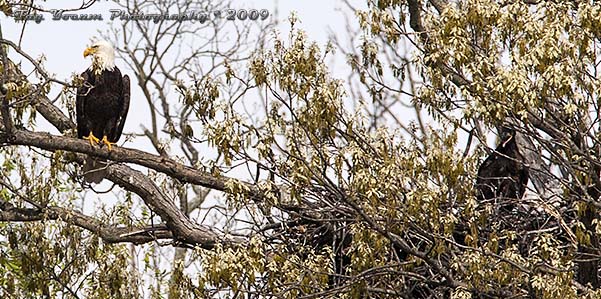
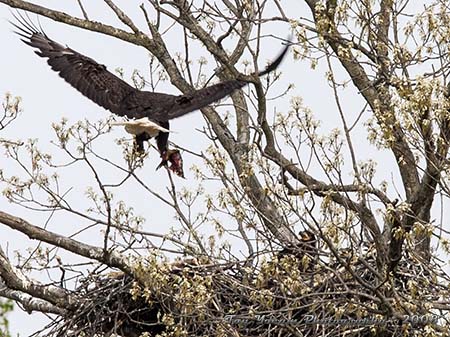
The adult bald eagle, pictured on the left in the above picture, stood guard over a nest of older eaglets almost ready to fledge. As the current year's eaglets get older, one parent will stay in the general area of the nest but move further away with time.
The American Bald Eagle is America's national emblem and is protected by law. Because of DDT usage in the 50s and 60s, the number of nesting pairs dropped to less than 450. Once the use of DDT was stopped and the birds were protected by law, there were, as of 2020 (the last available data), 71,400 nesting pairs. What a success story! A new danger has arisen. The large wind turbines are now killing Bald and Golden eagles that get too near them and get sucked into the blades. Even so building, cars, and communication towers still kill most of the birds and raptors.
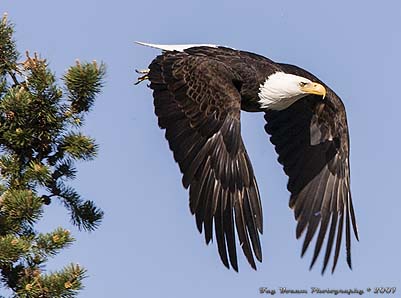
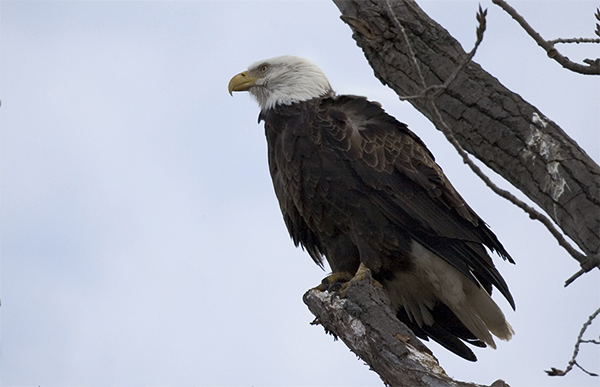
The Bald Eagle's distinctive white head, neck, and tail make it easy to spot. It has a brown chest. Bald Eagles have been confused with ospreys. The osprey has a white head with a brown stripe, but a white chest and a brown tail.
The male eagle is slightly smaller in height, wingspan, and weight than the female. This differs from most birds, where the males are usually bigger and prettier.
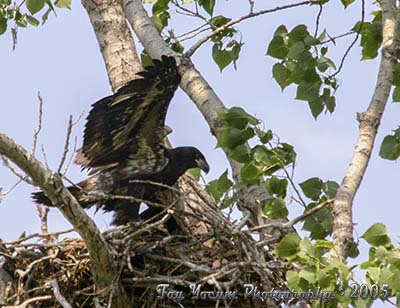
Juvenile bald eagles have a mixture of brown and white with a black beak. They do not get white feathers until they are about five years old.
This eaglet was seen in the Woodstown, New Jersey, area.
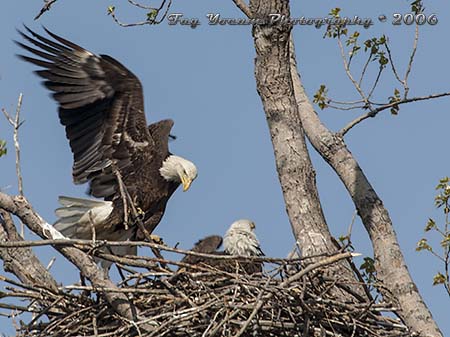
The parents mate for life and are both involved with raising the young. Here, one parent brings nesting material to prepare for the hatching of the young.
As the pair start nesting, they usually build two or three nests. One is their primary nest, and the others are called alternates. If the original nest were destroyed, they would move to a second location. Nests are built in the tallest trees near water, as their primary food is fish. They will eat carrion.
It can take one to three months to build a nest. The female brings in material and arranges the sticks. They may alternate among the nests they have built or reuse the same nest repeatedly. They refresh the nest when reused, thereby growing it into an impressive structure.
Guinness World Records lists the 1963 St. Petersburg, FL. Nest as the largest bird nest in the world. It was created by a pair of Bald Eagles and measured 9 feet 6 inches (2.9 m) wide and 20 feet (6 m) deep. It was estimated to weigh 4,409 pounds (two and a quarter tons).
Bald Eagles feed mainly on fish, but I have seen one carry home a snake. Because of their diet, they live along the coast and on major lakes and rivers. This picture was taken just to the east of the Mississippi River. One winter, I saw at least 60+ eagles, the best I could count, along the river just south of the Clark Bridge in Alton, IL.
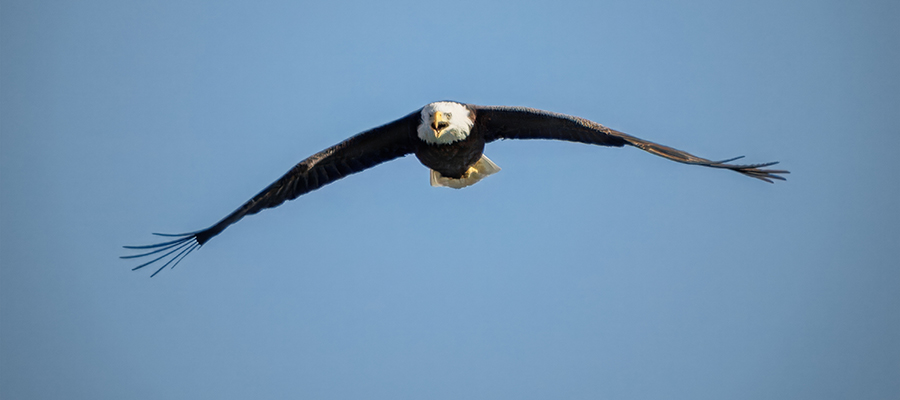
Bald Eagles can fly at 10,000 feet (15093 kilometers) and achieve speeds of about 30 - 36 miles per hour (48 - 58 kilometers per hour) in level flight. They can see fish from several hundred feet above the surface and see in color. While their eyes are almost the same size as a human's, they are four times as sharp.
Eagles also hunt from tall trees. When catching a fish, the eagle swoops down and grabs it with its very sharp and strong talons, often just getting a few tail feathers wet.
Ospreys, on the other hand, will hover over a spot where they think they see a fish and then plunge into the water, getting their whole bodies wet.
Eagles weigh about 10.5 pounds (4.76 kilograms) and can stand 34-43 inches (86 to 109 centimeters) tall.
Below the picture carousel, follow the links to the different birds of prey featured on this site.
American Bald Eagle
For a strong bird they have a weak sounding calls.
Bald Eagle
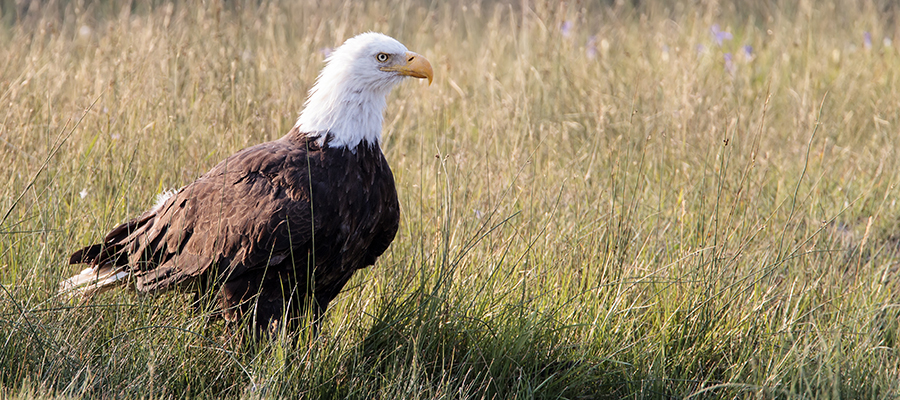
This eagle ate some carrion, then came over to the river to get a drink of water.
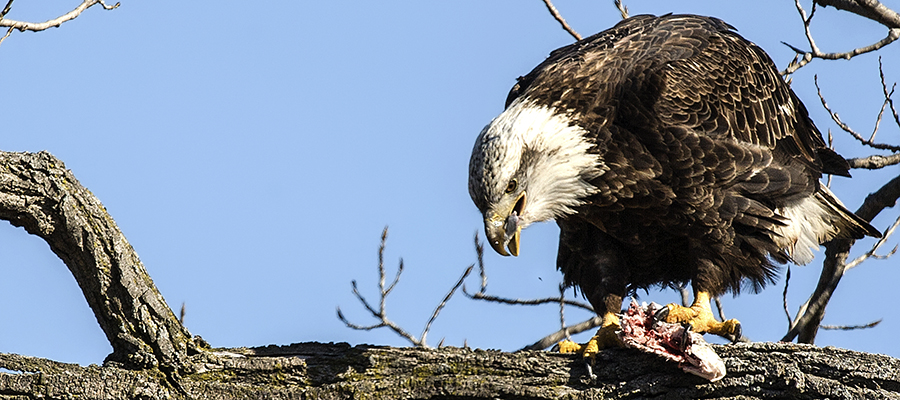
American Bald Eagle
One of the first pictures I took with my new 600 mm lens. I am not ashamed, I am tickled with this image.
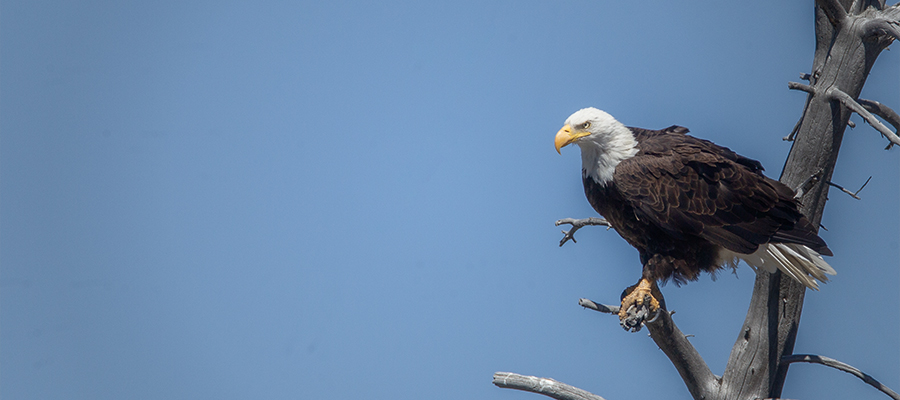
A Eagle Hunting
Bald Eagles will sit in the tops of trees looking for food. They can see prey about three miles away. Their eyesight is 4-5 times better than humans'. Hence, the phrase eagle-eyed.
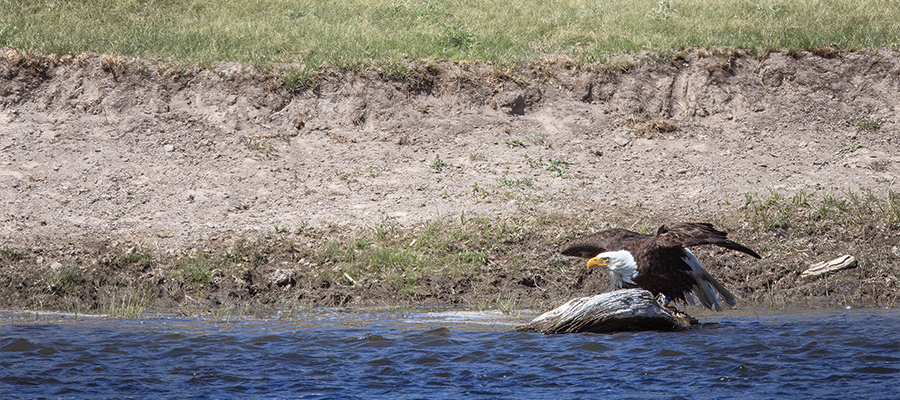
American Bald Eagle
This Bald Eagle had landed in the water and is getting ready to lift off from the Yellowstone River in Hayden Valley.