Black Sand Basin
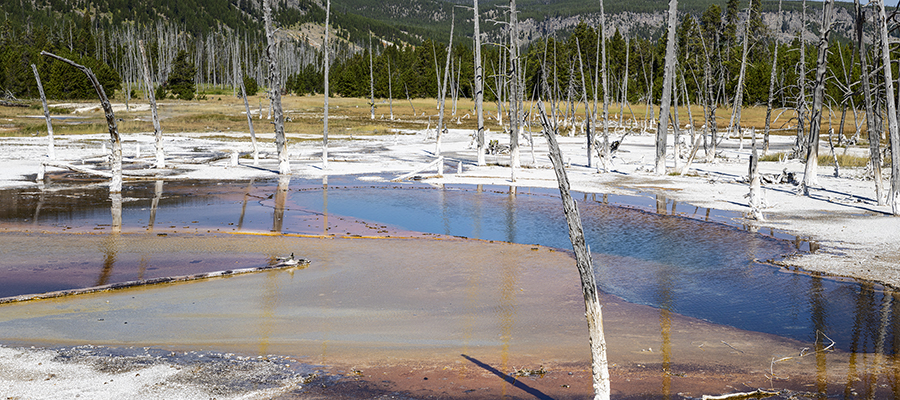
Link to enlarged panorama image.
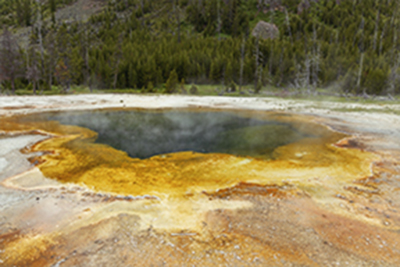
Black Sand Basin is a 1/2 mile north of the turnoff to Old Faithful on the west side of the road. Black Sand Basin is the home of Cliff Geyser, Spouter Geyser, Opalescent Pool, Rainbow Pool, Emerald Pool, and Sunset Lake.
Black Sand Basin is part of the Upper Geyser Basin, as is the Biscuit Basin. They comprise about two square miles of the 3,471 mi2 that make up Yellowstone National Park.
Black Sand Basin's name refers to the tiny obsidian particles that make up the sand throughout the area.1
The trail at Black Sand Basin is only 0.5 miles long on a flat boardwalk. Walkers and wheelchairs can easily access the sites. There is a bench as you go to Emerald Pool.
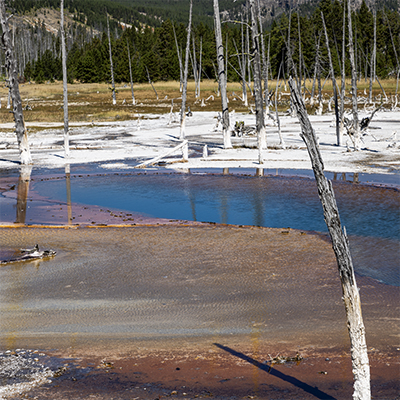
Opalescent Pool originally started as a depression that runoff from Spouter Geyser began to fill, but over time it has become its own beautiful-named feature. The temperature is 93.56° F (34.2° C).
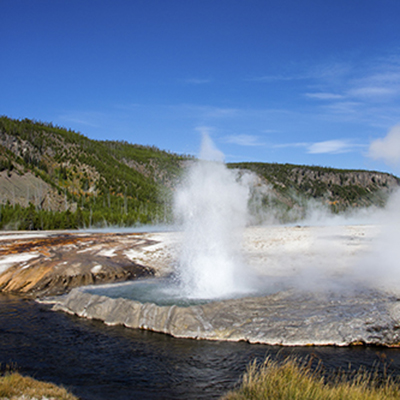
Cliff Geyser sits right on the edge of Iron Spring Creek, a small 5-mile-long creek that runs from the south to Biscuit Basin. Did you notice it runs north? Most of us expect rivers, streams, and creeks to run south, so what is up here? If you look at a Yellowstone map, you will see that Iron Spring Creek is north of the continental divide. Being north of the divide means the water flows towards the Pacific Ocean. South of the divide flows south towards the Gulf or the Atlantic Ocean.
Cliff Geyser sits right at the edge of the creek, so you are excused if you think the water for its eruptions comes from the creek. Sorry, you're wrong: the creek water isn't hot enough to support an eruption. Cliff Geyser. Riverside Geyser and any thermal features near running water have their own separate plumbing system, unrelated to the water flowing by. The water must be very hot for a geyser to erupt, and mountain streams don't meet that qualification.
Rainbow Pool and Sunset Lake are smaller pools than the better-known Grand Prismatic Spring, but they both can give you a water rainbow of colors due to the thermophiles at their edges. As you see here, the Rainbow Pool is blue in the center. It does not support bacteria, known as thermophiles, due to its temperature. What you are seeing is the reflection of light. As the temperature cools, as the water moves away from the hottest areas that prevent bacteria growth, bacteria can start growing in the cooler, but still hot, water. You will normally see lighter colors, white, yellow, and green, moving towards light than darker browns.
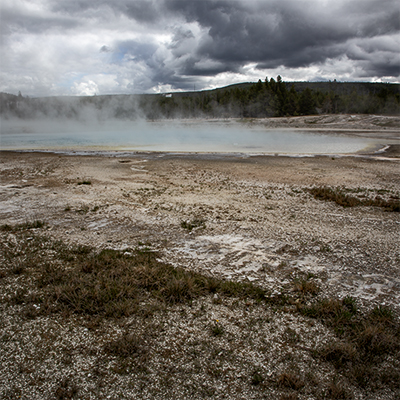
360-degree Views of Black Sand Basin
Click the images to see the basin differently. Clicking the pictures will take you to another page with a 360-degree view of the geyser basin. It will start moving automatically, but feel free to drag the image in ANY direction. Click the information button for information. Use your mouse scroll wheel to zoom in and out on the image. To return to this page, use the back button on your browser.
Spouter Geyser
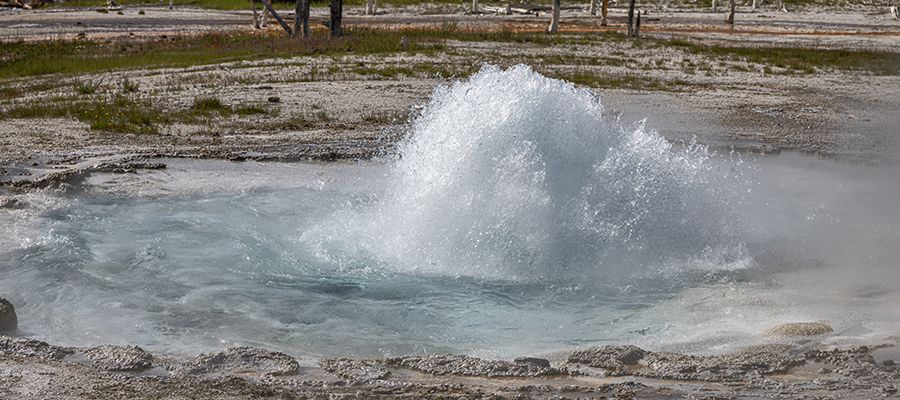
Spouter Geyser can be in eruption from 40 minutes to 3.5 hours. It erupts up to 6-8 feet.
Spouter Geyser
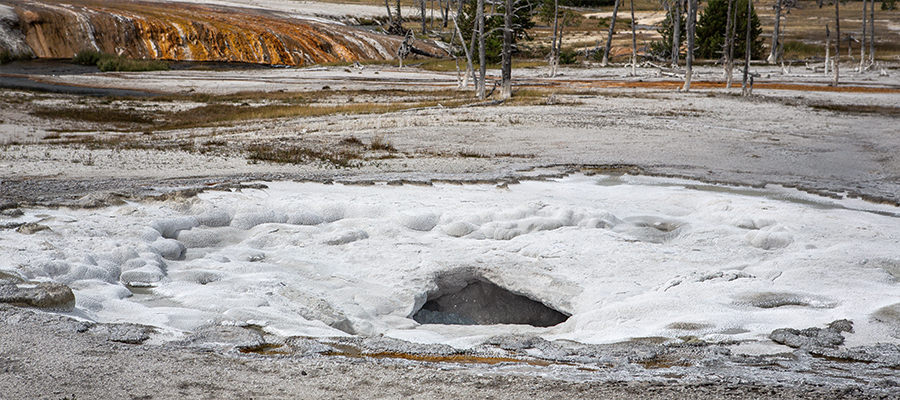
Spouter Geyser between eruptions, exposing the empty basin. If you look closely, you can see water splashing just behind the front edge of the opening. Meaning Spouter will begin to erupt soon.
Cinnamon Spouter Geyser
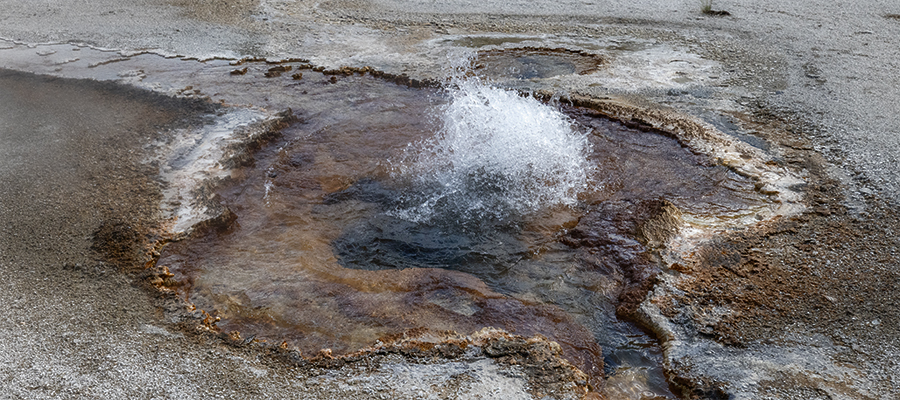
Cinnamon Spouter geyser fully developed in 1989 to the point that the boardwalk needed to be moved. Why? Because it opened below the then-current boardwalk.
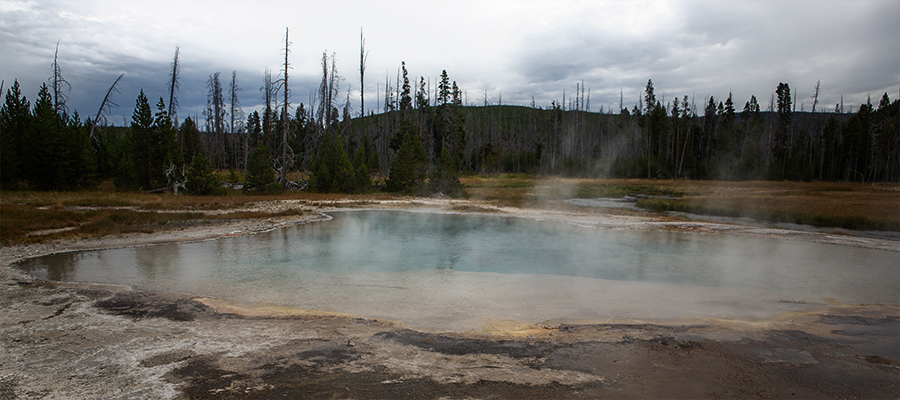
Green Spring
Green Spring is a very infrequently erupting geyser. Its last had was a brief bubble-shower in 2016.
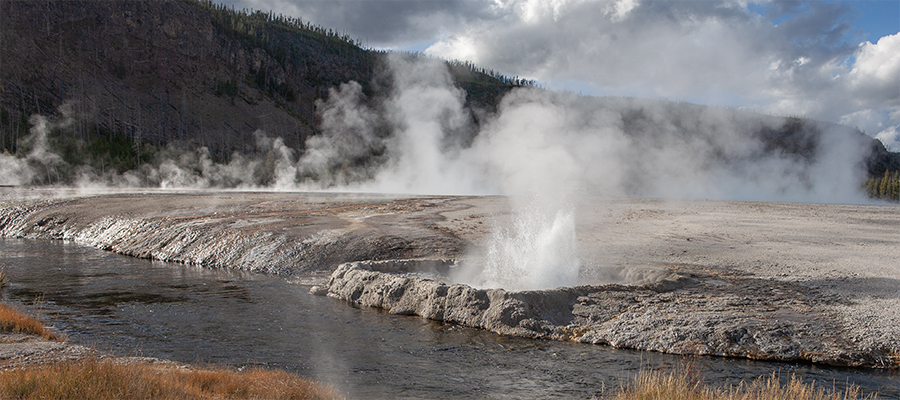
Cliff Geyser
Cliff Geyser erupting in front of Sunset Lake, on the right, and Rainbow Pool, on the left.
1Whittlesey, L. H. (2006). Yellowstone Place Names. Gardiner, MT: Wonderland Publishing Company. Page 53.