Flavors of History
History Synopsis of Yellowstone National Park

When it comes to history, there are several themes one can study. Geological changes, people, animals and their management, and events in the park’s history are all important in shaping what we experience today when we visit Yellowstone National Park. How have we, events, and nature caused changes? What has been the impact?
Since I don’t intend to write a history book but rather give you some facts to pique your interest, I will condense this section into bullet points. Hopefully, it is short on verbiage and full of interesting facts. If any of these points pique your interest, take a little time to look into them further by visiting the many websites about Yellowstone, purchasing good books from the Yellowstone Association Book Stores/other retailers in the park, or asking a park ranger for more information.
So, let’s see how history impacted Yellowstone and how change shaped the history of Yellowstone.
Bang, Bang, Bang
Did you know that when you are in Yellowstone, you are in an active volcano? Three gigantic volcanic eruptions have formed what is now Yellowstone National Park. The volcanic explosivity index (VEI) scale measures the intensity of volcanic eruptions. The VEI ranges from 0 to 8. Each number represents a 10-fold increase in destructive power from the previous number. A rating of 8 is a staggering eruption. Two significant Yellowstone eruptions were an eight on the VEI scale. The 1980 eruption of Mount St. Helens rated only four on the VEI scale.1 Yellowstone eruptions include:
- 1st eruption was 2.1 million years ago, with ash falling as far away as the middle of Texas, Missouri, and Iowa.
- 2nd eruption was 1.3 million years ago and is the smallest of the three, with ash covering only Wyoming, Colorado, Iowa, and parts of South Dakota, Kansas, and Nebraska.
- 3rd eruption was 640,000 years ago and had the most significant ash dispersal. Ash fell as far away as the Gulf of Mexico.2
Events of Yellowstone's Past
- Native Americans have lived or traveled through the Yellowstone region for 11,000 years. Yellowstone became an important part of their lifestyle and culture. In today’s Yellowstone, 27 native American tribes have official ties with the Park. The Tribal Heritage Center at Old Faithful allows you to learn more about their culture, art, and history.
- A group of Shoshone Indians known as the Sheep Eaters lived in the area. They forsake the use of horses and guns.
- The explorer John Colter is probably the first Euro-American to see the Yellowstone area in 1806. Colter had been part of the Lewis and Clark expedition and requested permission to leave the expedition to travel solo in the area.
- Fur trappers and mountain men began telling stories about the hot springs and other thermal features. Often, these stories are considered tall tales. Who would believe that there were falls that spouted out of the ground and went up in the air?
- The first major expedition into the Yellowstone area was the Folsom-Cook-Peterson expedition in 1869. Their expedition sparked interest in the area.
- Then, the Washburn-Langford-Doane expedition in 1870 further explored the area. The Washburn expedition named Old Faithful Geyser because of its consistency in eruption intervals.
- On September 8, 1870, Truman Everts, a member of the Washburn Expedition, didn’t return to camp.
- The government’s first officially financed expedition was in 1871, led by Ferdinand Hayden. What would become very important to the park's establishment was the inclusion of a painter and photographer as party members. Many people have credited Hayden with leading the push to protect the area. Paintings and sketches by Thomas Moran and photographs by Henry Jackson assisted in persuading congress to act. View Thomas Moran’s art at https://americanart.si.edu/artist/thomas-moran-3406. To view William Henry Jackson’s pictures from the same expedition, look here https://www.nps.gov/people/william-henry-jackson.htm.
- On March 1st, 1872, President U. S. Grant made history when he signed the bill that made Yellowstone America's first National Park. The Organic Act of 1872 was signed after just 10 weeks of lobbying. The Act of Dedication or Organic Act of 1872 set aside the land for "the benefit and enjoyment of the people.…" The national park concept was born with the creation of America's first national park. Parks began to develop worldwide after that. The US Congress provided no funds to manage the park in 1872.
- In May 1872, Nathaniel Langford was appointed the first superintendent of Yellowstone National Park.
- In 1883, three men from the Laramie Bicycle Club of Wyoming made the first bicycle expedition into Yellowstone. The trip had to be grueling, since the roads were unpaved and the bikes weighed over 50 pounds. Bikes at that time were called “ordinary.” The front wheel was 3 to 5 feet tall, and the back wheel was tiny. The rider was perched over the front wheel.3 Ordinaries were dangerous bikes because striking a rut could cause the rider to pitch forward over the handlebars, causing fractures of bones, including the neck.
- On August 20, 1886, the regular army troops arrived to protect the park. The first attachment included 33 men under the leadership of Captain Moses Harris.
- On March 2, 1889, Martha “Mattie” Shipley Culver died. She was the wife of the winter keeper of the old Firehole Hotel. She died from TB and was buried in a grave located at the Nez Perce picnic area on Fountain Flat Drive. When Mattie died, Yellowstone was still a frozen winter wonderland. Until Mr. Culver could dig a grave in the frozen ground, the question became what to do with her body. The solution was that her body was first placed into two barrels placed end-to-end and buried under the snow to protect her from carnivores. Her husband and a friend worked two days to dig her grave shortly after her death. Mattie’s grave is the only grave at that location.
- By 1900, only 23 indigenous bison remained in Pelican Valley. Since then, the herd has recovered, and it now has 3000-6000 head annually.
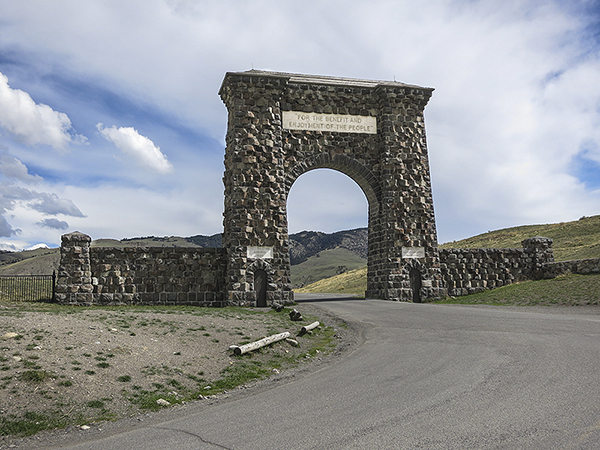
- On April 24, 1903, President T. R. Roosevelt laid the cornerstone of the structure now commonly called the Roosevelt Arch. While the structure was under construction, President Roosevelt was in the park on vacation, and he was persuaded to place the cornerstone. On that date, 3000–4000 people traveled to Gardiner, MT, to witness the cornerstone being laid. In his speech, the President stressed the words later etched in stone on the arch's face: "This Park was created and is now administered for the benefit and enjoyment of the people." In big, bold letters etched in stone, the arch reads: "FOR THE BENEFIT AND ENJOYMENT OF THE PEOPLE." So please enjoy Yellowstone while in the park and share your experiences with others on your return to your "normal" life.
- On May 28, 1903, Robert Reamers' blueprints were approved for building the Old Faithful Inn.
- One year and 2 days later, on June 1, 1904, Old Faithful Inn opened its doors and began hosting guests. Considering the hardship of the Yellowstone winter and the logistics involved, they worked a miracle.
- The first official legal entry of a newfangled automobile was on July 31, 1915. It was a Ford Model T.
- On August 25, 1916, President Woodrow Wilson signed the bill to create the National Park Service.
- All horse-drawn vehicles were prohibited in the Park by 1917, just two years after the official introduction of automobiles.
- Horace Albright became the first National Park Service Superintendent of Yellowstone National Park in 1919. He held that position for 10 years. The Albright Visitor Center and Museum in Mammoth Hot Springs was named after him.
- In 1926, the wolves were officially declared extinct in Yellowstone.
- The Hebgen Lake 7.5 earthquake on August 17, 1959, killed 26 people outside of the Park. Inside the Park, it damaged the Old Faithful Inn and altered the behavior of many thermal features. Some of the damage was reversed in 2012 with the repair of the iconic Old Faithful Inn 8-hearth fireplace.
- The last bear-feeding dump at Trout Creek closed in 1971. Yes, people thought of bear-feeding dumps as a way to encourage visitors.
- In 1973, fishing at Fishing Bridge was officially closed to protect cutthroat trout.
- The 1988 fires destroyed 36% of the Park.
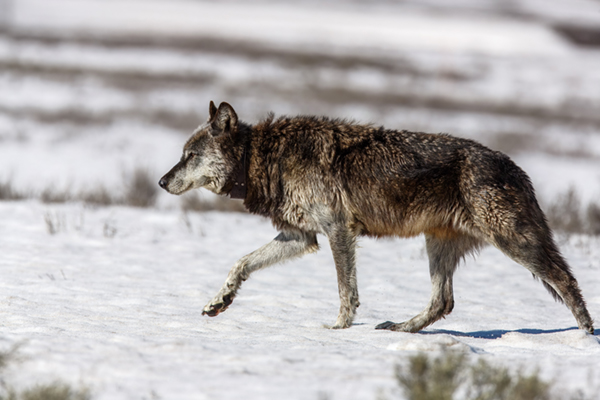
- The Park reintroduced the 14 wolves into the Yellowstone ecosystem in 1995. The wolves came from Canada.
- Suzanne Lewis, the first woman, was named the National Park Service Superintendent of Yellowstone in February 2002. Suzanne Lewis was superintendent for eight years.
- September 15, 2018, Ear Spring erupted for the first time since 1957. Causing multiple changes to Geyser Hill.
- On July 23, 2024, a large hydrothermal explosion occurred in Biscuit Basin.
So Much History
Yellowstone has only been a park for 150+ years. Its geological history goes back millions of years. You will understand that my short history lesson above doesn’t give you much. You could spend years reading about the history, but I wanted you to know that there are some fascinating things to know about Yellowstone. They are facts and figures that can only enhance your enjoyment of Yellowstone National Park.
You are encouraged to spend some time before or after coming to the park and check out various sources of information. Many books are available from the Yellowstone Forever Bookstores and their online website. Books are also available in all retail locations. More and more books about Yellowstone are appearing in ebook format.
It is interesting to see how change has come to Yellowstone, whether it is driven by nature or by some of our changes or adaptations. Unfortunately, some of our changes or adaptations were not beneficial, but we are learning from those mistakes.
Lake Hotel
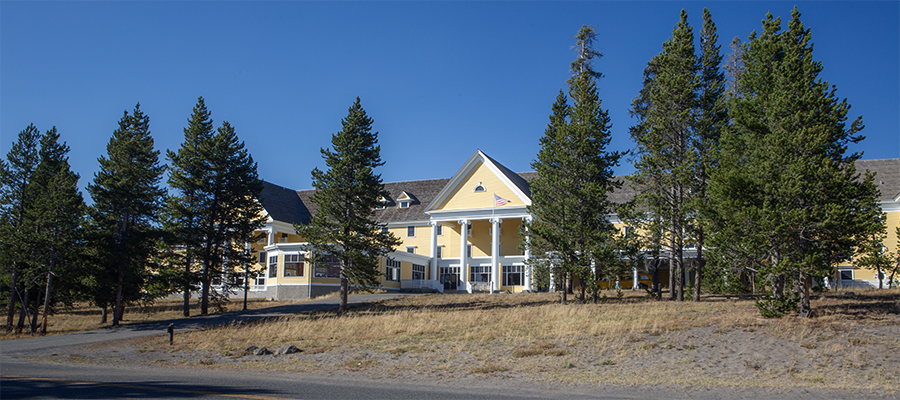
Lake Hotel is the oldest hotel currently standing in Yellowstone. The hotel was built in 1891, 12 years before construction began on the Old Faithful Inn.
Historical Yellow Bus
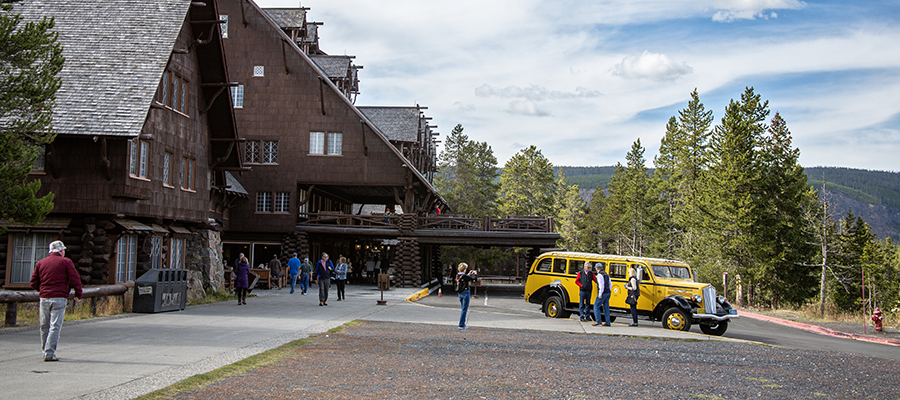
Vintage White Motor Co historic yellow buses built in 1936-1939. There are currently eight buses in inventory at the park. In the 1920s, there were 400 buses servicing park visitors.
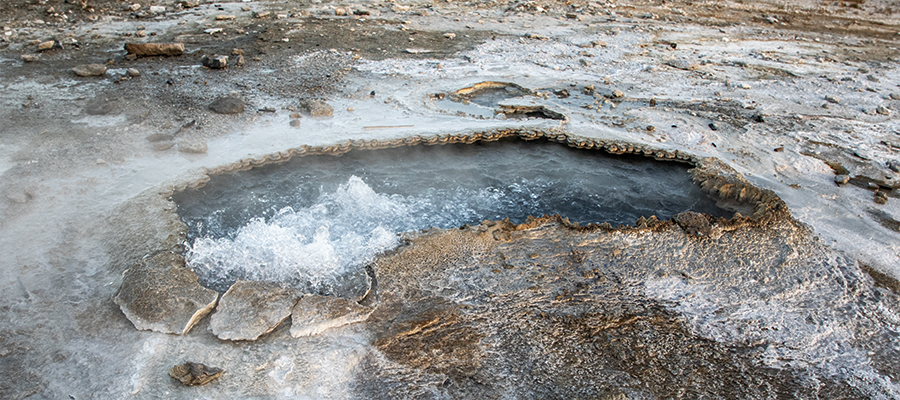
Ear Spring One Day after 2018 Eruption
Ear Spring erupted in 2018 for the first time since 1957. This image shows Ear Spring the next day, when it was still boiling hard, hard enough to break up the geyserite edge. The water's action would eventually float the broken pieces down and away from the geyser's edge.
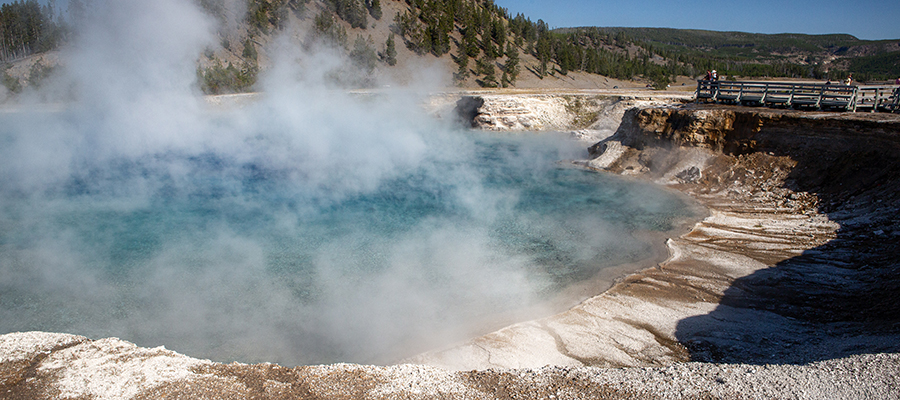
Excelsior Geyser Crater
Excelsior's last eruption occurred in 1985. It was the eruption before in 1880s that was so violent it created the crater we see today.
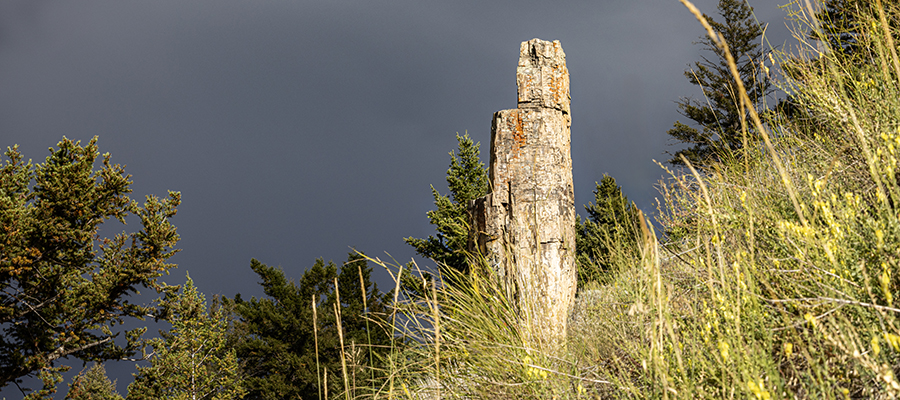
Petrified Tree
It can take hundreds of thousands to millions of years for a tree to petrify. These trees were covered by volcanic ash that halted their decay, allowing minerals to seep in and replace the organic matter.
1Fritz, W. J. & Thomas, R. C. (2011).Roadside Geology of Yellowstone Country. (2nd Ed.). Missoula, MT: Mountain Press Publishing Company, 63.
2Ibid. 65.
3Turner. E. H. (2012). It Happened In Yellowstone: Remarkable Events That Shaped History. (2nd Ed.). Guilford, Connecticut: Globe Pequot Press, 28 – 31.